Sunday, June 19, 2016

ERoEI is unimportant and is being used incorrectly

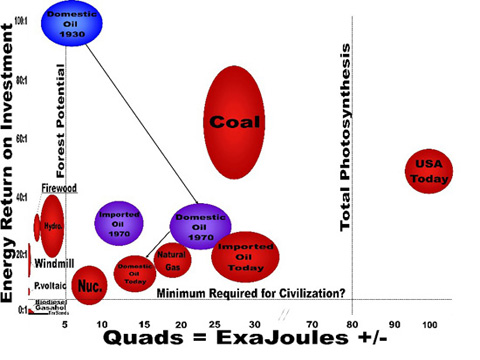
In this article I will show that ERoEI is unimportant by itself. It usually does not matter if ERoEI is increasing or decreasing. ERoEI provides no guidance about which sources of energy we should pursue, nor does it offer any guidance about how much net energy will be available to us in the future. By itself, ERoEI is a useless figure, unless it is lower than 1, which it almost never is. Although different sources of energy (such as coal or solar PV) have different ERoEI ratios, this means nothing important.

What is important to civilization (and to us) is the amount of net energy obtained from a source of energy. It is an amount of net energy (not a high ERoEI) which allows us to drive cars, fly airplanes, and so on. If we obtain 1 GWh of NET energy, then it does not matter if it came from a high-ERoEI source, or from a low one. What matters is the amount of net energy.

In turn, the amount of net energy depends upon two things: ERoEI AND the amount of gross energy. BOTH of those figures are required to determine the amount of net energy obtained. ERoEI by itself tells us almost nothing.

Let me provide an example, to demonstrate this point. Suppose you have a solar PV panel with an ERoEI of 3, which returns 1KW on average continuously for 30 years. In that case, the net energy provided by that solar panel is 175.2 MWh ((1*24*365*30)*(1-1/3)) over its lifetime. If, however you have ten such solar panels, then the net energy returned is ten times higher (1752 MWh), despite no change in ERoEI.

For the most part, the amount of NET energy we can obtain is determined by the amount of GROSS energy we can obtain, not by ERoEI. Usually, ERoEI is only a minor factor. This is because the difference in the amount of gross energy between sources of energy is so large that it completely overshadows any minor influence that ERoEI would have.

For example, suppose we had single 1KW solar panel, and the panel had a very low ERoEI of 4 (which is certainly an underestimate [1]). Even if you increased the ERoEI from the very low value of 4, all the way up to to infinity, so that no energy was required to replace that solar panel, it would make little difference--it would increase the amount of NET energy obtained by only 25%. On the other hand, if you could build 3 such solar panels, instead of 1, then you would triple the net energy obtained. In this case, building two more solar panels had 12x greater effect than increasing the ERoEI to infinity.

For the most part, the net energy obtained from solar power would be determined by the number of solar panels built, not by their ERoEI. In turn, the number of solar panels which can be built, is determined by non-energy factors like capital and labor, because those are the scarce factors which prevent the construction of more solar panels. Energy for investment is not scarce, because this planet is bombarded with 23,000 terawatt-years/year of solar radiation, which is vastly more than we will ever use. It is the scarce factors which determine how many solar panels we can build, and therefore, for the most part, how much net energy we will obtain. This point is complicated and requires further elaboration, so I will discuss it in a subsequent article. Suffice it to say, that the net energy of solar power is determined by non-energy factors such as capital and labor, and has almost no relation to ERoEI, because capital and labor (not energy) are the scarce factors which prevent the construction of more solar panels.

Generally speaking, the amount of net energy goes up as ERoEI declines, although it’s a weak correlation. This is because the amount of gross energy is vastly higher at lower ERoEI ratios, and the greater amount of gross energy more than compensates for any decline in ERoEI.

For example, solar PV could provide far more net energy than coal, regardless of its lower ERoEI. This is because solar radiation is so much more abundant that its lower ERoEI would be completely overshadowed by its greater amount. As a demonstration, suppose we could convert only 1% of solar radiation striking this planet into electricity using solar panels. In that case, we would obtain 40,000 times more electricity from solar power than we currently obtain from burning coal [2]. That figure does not take into account ERoEI, but it would make little difference. Even if solar PV had an extremely low ERoEI of 4 (certainly an underestimate), and coal had an ERoEI of infinity, it still would only reduce the maximum net energy of solar power by 25% relative to coal [3]. Since solar power is 40,000 times more abundant than coal, an ERoEI adjustment of 25% is not important. It would mean only that we could obtain 30,000 times more energy from solar power than from coal, rather than 40,000 times more [4].

Of course, if the ERoEI of some energy source were extremely low (like less than 2), then ERoEI would become an important factor. In that case, ERoEI would actually make a substantial difference, because it would cause a 50% or greater net energy loss. However, all common sources of generating electricity have ERoEI ratios far higher than that. With an ERoEI higher than 8 (which all sources of generating electricity have), the amount of energy spent obtaining more energy is only 12.5%, which is completely overshadowed by differences in gross amount between energy sources.

Again: net energy available is a function of BOTH EROEI AND AMOUNT. Either one of them by itself cannot be used to calculate net energy. If we wish to use a “rule of thumb”, then we should assume that MORE net energy is available at lower ERoEI ratios, but the correlation is so weak that it can’t be relied upon. In any case, ERoEI is not generally an important factor.

Unfortunately, ERoEI theorists do not realize any of this. Over and over again, they wrongly assume that ERoEI is somehow proportional to net energy. They assume that a higher ERoEI somehow implies more net energy obtained. This is a severe mathematical error, but it’s repeated endlessly throughout the ERoEI literature, across decades.

Let me provide some examples which I read just a few days ago:

“Look [at a] Cheetah… That beautiful and ultra efficient machine, needs an EROI of about 3:1... That’s a metabolic minimum EROI for mammals.Being the minimum EROI for any live being (mammals in particular) 2-3:1 in average, to be kept alive as species and for the couple to successfully breed their offspring (minimum of 2-3 per couple), probably Charles Hall is very right to state that a minimum EROI of 5:1 is required to have a minimum (very primitive and elemental) of civilization, beyond us living as naked apes.”
No, because that wrongly assumes that greater amounts of net energy are obtained at higher ERoEI. That is a basic mathematical error. Frequently, using a lower ERoEI source of energy will obtain more net energy than a higher ERoEI one.

The Cheetah example is also mistaken in other ways. The Cheetah doesn’t just have a low ERoEI; it also has TOO FEW prey which it can catch. If the Cheetah could eat prey every 5 minutes, then it would have a vast excess of energy even at an ERoEI of 1.5. The problem is that many animals eat only once per day and some animals (such as crocodiles) eat only once per week or so. The problem is amount, not ERoEI. If they eat only 10,000 kilocalories per week, then increasing the ERoEI wouldn’t matter much (even increasing ERoEI to infinity in this case would only gain the animal another 3,300 kilocalories). What would help is to catch MORE prey.

Here is another example of the same mistake:
We can take our ERoEI 20 FF and invest them in ERoEI 50 sources and make a huge energy profit. Or we can invest them in <5 and make a loss. Our policy makers have lost their heads electing to promote loss making activities.”

No, because that is confusing ERoEI with an AMOUNT of net energy. If an ERoEI were an amount, then spending fossil fuels with ERoEI 20 on solar panels with ERoEI 5, would imply a loss of 15. However, you cannot subtract the ERoEIs of different sources of energy, because they are not AMOUNTS which can subtracted. The correct mathematical operation is to multiply those two numbers, not subtract them.

If you take ERoEI 20 fossil fuels, and invest them in ERoEI 5 solar PV, then the aggregate ERoEI is 100 (invest 1 unit of fossil fuels initially, obtain 20 units of fossil fuels with ERoEI of 20 thereby, invest each of those 20 units in solar panels with ERoEI 5, then obtain 100 units at the end of it for an initial investment of 1).

Here is another example:
IMO, the only thing that could delay the bad impacts of declining high ERoEI FF is to introduce to the global energy mix an energy source that has higher ERoEI than the fuels they have to replace. Introducing low ERoEI energy sources simply makes things worse.”

No, because (again) that is confusing ERoEI with an AMOUNT of net energy. The “bad impacts” are caused by TOO LITTLE net energy, not a low ERoEI. Adding any source of energy with an ERoEI higher than 1 increases the total amount of net energy available. Only an ERoEI lower than 1 would make things worse. If the source of energy is cheaper per unit of net energy (as solar power actually is) then it is easier to obtain more net energy that way, regardless of its ERoEI.

…All three of the above quotations are taken from leading figures in the ERoEI literature, all published within the last few weeks. Granted, the ERoEI movement is a tiny fringe movement, but these people are among the leading figures of it. Over and over again, they wrongly assume that ERoEI and net energy are somehow proportional, and that higher ERoEI implies more net energy. That is a basic mathematical error. Frequently, the opposite is the case.


What matters is the AMOUNT of NET energy available to civilization, and that amount is far higher for renewables than for any other source, regardless of ERoEI.

* NOTE: In this article, I am using the term "ERoEI" to by synonymous with "EROI" and other spellings. I am referring to the amount of energy obtained for an investment of energy. If ERoEI for some energy source were extremely low (like lower than 3) then ERoEI would start to become more important, since we'd need to build significantly more power plants to generate the same net energy. Since all common sources of generating electricity have an ERoEI much higher than that, ERoEI is not important in any real-world scenario.

I revised this article on August 18, two months after its initial publication, to improve the flow of the text.

Thursday, May 21, 2015

Energy decline theory is pseudoscience

Here is a response I wrote on a forum:
I'm sorry, but there's just no science happening here. It's not sufficient to say the word "science" and to use scientific-sounding terms like "biophysical". Those kinds of things are also common within pseudoscience.

What is required are specific, falsifiable, risky predictions of things which weren't happening anyway. Then those predictions must be confirmed by subsequent evidence. That is the first step toward actual science, and it has never happened and is not happening within this group.

This group has all the hallmarks of pseudoscience. It has never produced any risky, falsifiable predictions which were confirmed by subsequent evidence, not even once. There have been massive failures of prediction, over and over again, but the theories remain totally unchanged, and the failures of prediction are not even addressed. Failures of prediction are handled by making the theory less and less falsifiable ("there is now a long descent which is difficult to see", see John Greer). Members do not respond to criticism, and leave errors uncorrected when they are pointed out. Notably, this group is ignored by legitimate researchers. There is almost no interconnection between this group and actual legitimate fields of study, and this material is rarely cited outside this group. Notably, it appears that this group settles its conclusions in advance ("civilization is about to collapse"), then generates theory after theory which all lead to that conclusion, but then the predictions all fail.

If you guys want to start doing science, then you need to respond to criticism without badly misreading it, modify your theories in light of failed predictions, and make falsifiable, risky predictions which are confirmed by subsequent evidence. Those things would be the first steps toward actual science, but those things are just not happening here.
----

Here is another post from the same thread:
George, you said:
"I'm talking about net free energy per capita, not raw energy produced... The numbers you quote do not take into account the amount of that energy it took to obtain that amount...So with slowing net energy increase and increasing total population the amount of usable energy for the economy per individual is in decline."

No, that's clearly wrong. Let's do the math. According to the EIA's numbers, world energy consumption has increased from 480x10^15 to 524x10^15 btu, between 2009 and 2013 (inclusive). At the same time, world population increased from 6.83x10^9 to 7.08x10^9 people (http://www.geohive.com/earth/his_history3.aspx). That means that per-capita energy consumption has increased from 70.27x10^6 btu/capita to 74.01x10^6 btu/capita in that time. In other words, per capita energy consumption increased by 5.3% in 4 years, which is a compound growth rate of ~1.3% per year.

Now let's look at the prior 29 year period, from 1980-2009 (inclusive), using the same sources of data. Per capita energy consumption increased from 63.63x10^6 btu/capita to 70.27x10^6 btu/capita over 29 years, which is an increase of 10.4% over 29 years or only ~0.35% per year.

In other words, per capita energy consumption is not only increasing, but the rate of increase accelerated. The growth in per capita energy consumption was much faster during the period of 2009-2013 than during the prior 29 years.

Those figures are not EROI adjusted. It's impossible to find reliable statistics on worldwide average EROI.

However, it's totally implausible that average EROI worldwide has dropped by an amount sufficient to erase that acceleration in energy consumption. Even if EROI had been stable and had not declined at all over 29 years, and then suddenly dropped from 30 to 15 (a decline by half, which is totally implausible) in only the 4 year subsequent period, the EROI-adjusted per capita energy consumption still increased faster (0.5% vs 0.35%) during the period from 2009-2013 than during the prior 29 years.

The straightforward conclusion from this, is that per capita energy consumption is increasing, and the rate of increase has sped up, no matter what you think happened to EROI (within reason).

I don't know how you arrived at the conclusion that "usable energy ... per individual is in decline". Your statement is not compatible with the data which hitssquad just presented.

This is exactly the opposite of what energy doomers had predicted. They had confidently predicted a sudden collapse of civilization in the late late 2000s and rapid declines in energy consumption. What happened was the opposite of what they had predicted, yet again.
The consistent and severe failure of prediction from these theories implies that there is something seriously wrong with them. It's long overdue to start asking what is wrong.

---

Here is another post from the same thread:

Hi Harry,

I just read through the comments again, and came across yours. You said:

"Could you be very kind and point me to some of those suggestions? I am about to radically decouple!"

Harry, are you going to radically decouple because you expect civilization to collapse soon? If so, you're about to throw your life away. Civilization is not collapsing for these reasons. The most recent collapse predictions from this group are no more scientific, and no better founded, than any of their other collapse predictions over the prior decades.

This material is just totally wrong. It's littered with severe errors that invalidate its conclusions, it's ignored by almost all relevant experts, it does not meet the minimal criteria of a valid scientific theory, and it's characterized by massive, repeated failures of prediction without any corresponding correction of the underlying theories.

There have already been many people who moved out into the wilderness circa 2005 in expectation of a drastic collapse of civilization, for these reasons. They wasted ten years of their lives on a fringe doomsday theory. Do you really want to join them? Of course, you can do whatever you want, but you should clearly envision what you will feel like when five or more years have passed and civilization hasn't collapsed and not that much has happened other than you living in the middle of nowhere.


The original conversation is here.

Monday, May 11, 2015

Six Errors in ERoEI calculations

The ERoEI ratio refers to the amount of energy which we must expend in order to obtain more energy. For example, if we must use one barrel of oil in order to drill for another three barrels of oil, then the ERoEI ratio of the oil we obtained thereby is 3:1, or just 3. As another example, it may take one bushel of coal worth of energy in order to mine 10 more bushels of coal, in which case the ERoEI of the coal we obtained is 10:1, or just 10.

Different sources of energy have different ERoEI ratios. Some sources of energy (such as coal) have high ERoEI ratios, typically more than 20:1, which indicates that coal requires very little energy expenditure to obtain it. Other sources of energy, such as oil, have much lower ERoEI ratios. Some sources of energy, such as corn ethanol, take as much energy to obtain as they will yield. They provide no leftover energy to society, and have an ERoEI of 1.

The ERoEI of various energy sources has been calculated throughout various papers on that topic. There are at least 30 papers calculating the ERoEI ratio for various sources of energy such as nuclear, coal, solar PV, and others.

Unfortunately, the reported ERoEI ratios for any given energy source are often widely divergent from one paper to the next. For example, Weissbach et al[1] report an ERoEI of 75 for nuclear power, whereas another study[2] reports an ERoEI of less than 1 for the same energy source. As another example, the ERoEI of solar PV is reported as 2.3 in Weissbach et al's paper[1], and the high 30s in another paper[3]. Those kinds of discrepancies are common throughout the ERoEI literature.

Much of those discrepancies are caused by errors in the calculation of ERoEI which I will detail here. Once these errors are corrected in the offending papers, the resultant ERoEI ratios for different sources of energy become much closer together.

The errors are as follows:

Error #1: Energy returns are repeatedly treated as energy investment

It's crucial not to count energy returns as energy investment, because they are different things. It would be incorrect to include energy returns as energy investment. It would yield the wrong result. However, this mistake is made repeatedly in the papers of Charles Hall and others.

As an example, the paper[4] from C Hall (What is the Minimum EROI that a Sustainable Society Must Have?) calculates the EROI of oil. However, it includes  the energy cost of freeways, automobiles, and so on. That is a mistake, because those things are energy returns, not energy investments to obtain energy. If I drive my car down the freeway, and I'm not doing so out of necessity for gathering coal, then it was because of energy returns.

If you include all energy returns as energy investment, then the EROI of every energy source is 1. This is an application of the first law of thermodynamics. It would be highly surprising if we got more energy out of an energy source than was present within it. As a result, it is not surprising that the EROI of any energy source will converge to 1, as returns are included in the denominator. However, that does not yield any useful information, because it does not tell us how much energy is left over after obtaining the energy to provide for consumption. That is just a roundabout way of testing the first law of thermodynamics--something which has already has been tested and which could be tested far more directly. If we wish to find how much energy is left over as a return, then we must exclude returns from the denominator.

Many of the conversions of money to energy, which are found throughout the EROI literature, are implicitly committing this mistake. For example, in Hall's papers such as Spain's Photovoltaic Revolution[5] and the accompanying presentation[6]. On pp 12 of that presentation, there is a conversion of money into energy units, in order to find the energy cost of things like accountants employed by solar companies, etc. The formula presented is "At 1 Toe = 42 GJ, this represents 5.12MJ/Euro" which is derived from dividing the GDP with all energy usage in the entire country (Spain). That is a mistake, because most energy usage in the country is energy returns, not energy investment. To correct this mistake, Hall et al should take the total energy return for the country as a whole and divide it by the ERoEI which prevails for the country as a whole.

Performing this correction (assuming an average EROI of 10 for the country), by will increase the reported ERoEI of solar PV for that paper from 2.79, to 5.22. The figure of 5.22 is much closer to other reported ERoEI calculations for solar PV. This correction was performed by dividing all values by 10 which were the result of a money conversion as found in the chart on pp 12 in the above presentation[6].

Error #2: Lifetime estimates are incorrect

Many papers wrongly assume that the lifetime of an energy source is identical to its warranty period. For example, Hall et al's book[5] indicated above, and Weissbach et al's paper[1], both assume that the lifespan of a solar PV module is 25 years because that is the warranty period.

It would be highly surprising if solar PV cells failed on exactly the day their warranty expired. For example, I bought a car with a 50,000 mile warranty, but it didn't cease working at 50,000 miles.

The reason manufacturers are offering a 25 year warranty on solar cells is because they expect the vast majority of cells to last longer than that.

This error has a large effect on calculated EROI. In Weissbach et al's paper[1], the EROI of nuclear is calculated as 75 but the EROI of solar PV is calculated as 3.8, partly because nuclear plants are assumed to last twice as long as their original rated lifespan based upon observations, but solar cells are assumed to fail the exact day their warranty expires.

Even worse, many EROI papers contain incorrect aggregations of lifespan estimates. For example, C Hall's book[5] includes energy costs for things such as access roads to the solar plant, metal fence posts around the solar plant, concrete in the foundation, steel frames for the solar cells, etc. These things are grouped together with the solar cells themselves and are therefore wrongly assumed to have the same lifespan as the cells themselves. Even if the solar cells spontaneously stop working the very day their warranty expires, the rest of the plant (access roads, fences, steel frames, canals, and so on), will certainly last much longer, and would be re-used.

Error #3: Not counting embedded energy which is recovered

Papers about EROI frequently include the "embedded energy" cost of components for an energy source. For example, calculations of the EROI for solar PV often include the "embedded energy" in the aluminum frames which support the solar panels in the field.

If embedded energy is counted on the way in, then it must also be counted on the way out. These papers uniformly fail to account for the energy which is recovered when the aluminum is recycled when the frames are dismantled. The recovered energy should be counted because the aluminum will be recycled. Almost all major corporations recycle structural materials such as aluminum because they save money by doing so.

This factor alone has a large effect on the reported EROI of solar PV. Much of the energy for solar PV is actually devoted to the aluminum frames which support the panels. About 75% of the energy for manufacturing those panels would be recovered when the panels are decommissioned.

In J Lundin's paper[7], there was some confusion expressed over how much recycled material should be assumed within incoming aluminum used to build solar frames. In my opinion, the incoming aluminum should be counted as 100% virgin, and the outgoing aluminum must also be counted, and should be counted as 100% recycled minus the energy costs of recycling. This is the only correct way. If recycled aluminum is used when a power plant is constructed, then the recycled portion is displacing the usage of that recycled aluminum elsewhere, which would require precisely that amount of aluminum to be made from raw materials for something else. Thus, 100% of the aluminum used for construction of the plant should be counted as virgin. However, 100% of the aluminum which is recovered should be subtracted from energy investments (not including the energy used to recycle the aluminum) because that is displacing aluminum which would have been made from virgin material elsewhere.


Error #4: Waste heat losses are counted as energy returns

This is a recurring problem throughout the ERoEI literature. Waste heat should not be counted as energy returns because it is not usable as energy to society. The only exception is when the waste heat is actually used for something (such as combined heat and power plants), but this is rare.

This factor is parcticularly important when computing the ERoEI of oil. Oil is refined and then used as transportation fuel within vehicles. Those vehicles have engines which convert the chemical energy in fuel to kinetic energy (movement). However, the engines lose about 70% of the energy in the fuel during the conversion. This must be counted as an energy loss. As a result, the EROI of oil is overstated almost everywhere by at least a factor of 3.

In fact, it might be useful to abandon the ratio "EROI" in these cases, and adopt the ratio "thermodynamic work over energy investment" or TWoEI. It is work which we want in the economy, not waste heat.

This factor is especially important when considering the oft-repeated figure that "oil had an EROI of 100 back in 1930". This comment is frequently repeated by the doomsday prepper sect. In fact, that EROI of oil back in 1930, does not include refinery losses, nor does it count losses in internal combustion engines which were even less efficient back then. If I perform a back-of-the-envelope calculation which takes into account those two factors (100*0.7*0.15), I obtain a corrected EROI of 10.5 for oil in 1930, not 100.

Error #5: Outdated figures are used

Frequently there are large discrepancies in the EROI calculations because different technologies are assumed when calculating energy inputs. For example, there are large discrepancies of the reported EROI of nuclear power. That is partly because some papers[1] calculate the EROI using gas diffusion enrichment of uranium, while other papers calculate the EROI using centrifruge enrichment[8]. Those different assumptions will yield very different EROIs for nuclear power, because centrifuge enrichment is so much more efficient. This factor is a large part of the energy investment for nuclear power, and so has a big effect on the resultant EROI.

When calculating the EROI of an energy source, we should use the most modern technology when calculating energy inputs. We wish to know the EROI of an energy source going forward, not the EROI of an energy source if we had built it years ago.

As an example, the paper by Weissbach et al[1], in its calculations of the EROI of solar PV, assumes the Siemens process is used to generate solar PV grade silicon. However, that process has been supplanted by processes which use only 40% of the energy[9]This factor by itself increases the EROI of solar PV in Weissbach's paper from 3.8 to 6.6.

Error #6: Invalid Comparisons Are Made

The are actually different types of EROI depending upon where the boundaries are drawn for calculations. When calculating the EROI of oil, do you include refinery losses? Energy losses for the transport of oil? Waste heat losses from the car? And so on. Each one of those calculations represents a different type of EROI. Some EROI calculations attempt to include only energy inputs used for extraction at the mine mouth, whereas other EROI calculations attempt to include every energy investment in the entire economy, such as the energy investment for building rail lines to transport the coal. Those are different types of EROI.

EROI figures should not be compared if they draw the boundaries very differently. For example, there was a very famous graph from Charles Hall which makes such comparisons[9] (found here). That graph spread like wildfire throughout the peak oil community. However, that graph is repeatedly comparing different types of EROI figures which are not comparable.

For example, the comparison of the EROI of coal (about 70) to nuclear (about 10), taken from that graph. There is a big difference in the kinds of EROI for those two sources. The figure for coal is before waste heat losses are subtracted for generating electricity, whereas the figure for nuclear is after waste heat losses are subtracted. When a correction is made for that, coal has an EROI of about 24.5, compared to nuclear of 10. The discrepancy has been reduced considerably.

As another example from the same graph, oil from 1930 is reported to have an EROI of 100, whereas hydroelectric is reported to have an EROI of 30. However, the EROI of oil from does not include refinery losses and waste heat losses from interal combustion engines in 1930. Correcting these factors yields an EROI of 10.5 for oil in 1930, not 100. Of course, hydroelectric also suffers from electrical resistance losses which reduces its EROI to perhaps 25. However, the adjusted EROI ratio for oil has gone from much higher to much lower when an adjustment is made so the figures are comparable.


Conclusion

The six errors described above are widespread throughout the ERoEI literature. They are partly responsible for the wide discrepancy between reported ERoEI findings.

For example, Charles Hall et al's book[5]Spain's Photovoltaic Revolution, is committing errors #1, #2, #3, and #5. When I correct those errors and re-calculate, I obtain an EROI of 6.27 for solar PVnot 2.79 as reported.

Weissbach's paper[1] calculates an EROI of solar PV at 3.8. However, that paper is committing errors #2, #3, and #5. When I correct those errors, I obtain an EROI of 12.96, and not the 3.8 which that paper reported. Incidentally, that paper also calculates the EROI for solar in a cloudy site in Germany, and then generalizes that to the EROI of "solar PV" altogether. If I correct that factor also, and use the average insolation for the inhabited northern hemisphere, then I obtain an EROI figure of 22 for solar PVwhich is much higher than the reported figure of 3.8.

Finally, even the concept of EROI has problems. Perhaps net energy should be expressed or reported differently, using a different ratio. This is because EROI gives an exaggerated impression of the difference between energy sources. For example, assume a hypothetical energy source with an EROI of 10,000, and compare it to an energy source with an EROI of 10. The source with an EROI of 10,000 would require 0.0001% of its output (1/10000) to build another like it, whereas the source with an EROI of 10 would require only 10% of its output (1/10) to build another like it. In other words, a reduction in EROI of 99.99% led to a reduction of net energy output of only 10%. This is because EROI is less and less important as it becomes higher. Instead of using EROI, we should calculate net energy as 1-(EI/ER), and then express that as a percentage. For example, if natural gas has an EROI of 15 (everything included such as infrastructure), and solar PV has an EROI of 6.27 (everything included), then their inverted ratios are 93% and 84% respectively. This means that 7 percent of the energy from the gas plant is necessary to build another gas plant, whereas 16 percent of the energy from the solar plant is necessary to build another solar plant. The net energy available to society has declined by only 9% despite EROI falling by more than half. Thus, EROI figures give an incorrect impression, and should be calculated and reported differently.

When all the problems above are corrected, it's unclear if there is any significant difference in net energy between different methods of generating electricity. The highest EROI source (hydroelectric) requires 1.3% of its output to build another hydroelectric dam, whereas the lowest source (solar PV) requires 16%. This implies only that we would need to build slightly more solar cells (~15% more) to obtain the same net energy. Any EROI more than 5 or so makes little difference (20% at most). All common methods of generating electricity seem to exceed that threshold.

Certainly, we should investigate further into this matter. If any method of generating electricity has a disastrously low EROI (lower than 4 or so, everything included) then it would be very helpful for us to know about it. Hall's work is very useful in this regard, insofar as he attempts to include all energy investments, which will give us better approximations of relative EROIs. However, we must avoid the above mentioned errors in performing our calculations.

p.s. This paper should be seen as a draft. I will update it if any relevant objections are made.

Sunday, April 26, 2015

Civilization would rapidly rebound after a catastrophe

Here is a comment I wrote in response to an article. The article was asking whether industrial civilization could be reconstituted from scratch after a worldwide collapse. The author argues that it would be more difficult to rebuild, now that the best fossil fuels are depleted. I argue that it would be easier to industrialize the second time around. As follows:

I think that industrial civilization would be reconstituted fairly quickly, like within two centuries.
In my opinion, It would be FAR easier to industrialize the second time, despite fewer and worse fuels. Any reborn civilization would progress through the industrial revolution far faster, and far easier, than we did originally. That is because they would start with our technical knowledge, which would more than compensate for any degradation of fuel quality.
For the first 80 years, up until about 1790, steam engines had an efficiency of just 1%. Early steam engines lost 99% of their coal energy as waste heat. This was because nobody had invented the Watt engine, the Corliss engine, the Wilkonson boring machine, the compound engine, and the Parsons engine. Those basic inventions in steam technology increased the efficiency of steam engines from 1% to 15%. In other words, that basic technical knowledge allowed steam engines to obtain 15x as much power per unit of fuel. A triple expansion steam engine from 1890 is not much harder to manufacture than a Newcomen engine from 1790, but it provides 15x the work per unit of fuel. Simply understanding the basics of thermodynamics and how to build a more efficient steam engine, results in a 15x advantage.
Any reborn civilization would start with that knowledge. They would start with engines which produce 15x the power, per unit of fuel. That advantage would more than compensate for any degradation of fuel quality. Does coal really have 15x as much energy as charcoal? The answer is no.
If industrial civilization was able to advance with 1% efficient engines, then it would be able to advance with 15% efficient engines. That advantage would far outweigh any degradation of fuel quality.
As long as a few textbooks survive and those textbooks describe how to build such engines, then industrial civilization would bounce back fairly quickly. Any new industrial revolution would be far faster than the original one.
After that, if we retained even 15 textbooks about basic physics, chemistry, thermodynamics, electricity, inventions, and so on, it would be enough to bring us well into the 20th century fairly quickly.
(The original article, to which this was a response, is here.)

Monday, September 1, 2014

World trade is not ending

Peak oilers and energy decline theorists both believed that world trade would rapidly come to an end around 2005. They believed that world trade would collapse as oil peaked and started declining, or as a consequence of declining ERoEI. This was one of the cornerstone beliefs of the peak oil and energy decline movements.

As usual, it was totally wrong. World trade did not collapse. In fact, the opposite happened. World trade, and especially ocean-going trade, has increased tremendously since that time. For example, the panama canal is now booked to capacity every single year, and must be expanded. The Suez canal must also be expanded.

In this article I will examine why world trade has not collapsed, and why it is not collapsing in the foreseeable future. I will divide my discussion into separate sections for the different modes of transportation (ships, trains, and trucks) and will explain why the transportation of cargo for that mode is not declining.


SHIPS

Cargo transportation by ship will not decline in the foreseeable future. That's because ships are becoming more fuel-efficient at a rate of about 2% per year and will continue doing so for decades, thereby offsetting any declines in oil production.

To a significant extent, shipping companies choose the fuel efficiency they want. Shipping companies could easily order ships with twice the fuel efficiency as those of today. Or, they could order ships with half the fuel efficiency. Ships which are more fuel-efficient are more expensive, so are only worth it when fuel prices are high enough to justify the added cost of the more expensive ship. As fuel prices increase, however, shipping companies order more fuel-efficient ships, and thereby drive down the amount of fuel consumed per ton-mile, and offset the decline in oil production.

The fuel efficiency of ships is a function of their size and speed. Larger and slower ships are far more fuel efficient. By halving the speed of a ship, fuel consumption is reduced by 75% per ton-mile. Furthermore, by quadrupling the size of a ship, fuel consumption is reduced by another 50% per ton-mile. As a result, a ship which is 4x the size and half the speed, consumes only about 12.5% as much fuel per ton-mile.

Ships have been getting much larger and slower over the last few decades. As a result, the amount of fuel per ton-mile has been deceasing for decades, and continues to decrease. When oil prices tripled back around 2006, the largest shipping company (Maersk) responded by ordering the triple-E class of ships which consume half the fuel per ton-mile as the average long-distance ocean ship of today. Other shipping companies followed suit. By just ordering the same kind of ship for the next 30 years, shipping companies will reduce the amount of fuel per ton-mile by half over that period, as they gradually retire their older and less-efficient ships and replace them with more efficient ones.

As a result, even if oil peaked today and declined by 2% per year for the next 30 years, we could still deliver the same amount of cargo in 30 years as today, because of increases in fuel efficiency which are happening anyway and will offset declines in oil production. By just ordering the same kind of ships which they are ordering now, the fuel consumption per ton-mile will drop by half over the next 30 years as older and less-efficient ships are retired.

Of course, there is a limit to the fuel efficiency of ships. When ships are traveling at only 8 knots, it saves no fuel to slow down any further. Also, ships could only be made approximately 4x larger than those of today before they start to buckle under their own weight. As a result, it would be impossible to improve the fuel efficiency of ships by more than 8x relative to today.

However, that is still enough to offset any plausible declines in oil production, well into the future. Even if oil production peaks in 2020 and follows a bell-shaped Hubbert curve, the shipping industry will offset the declines of oil by increasing the efficiency of ships, until at least 2050.

Of course, it would be possible for shipping companies to accelerate the improvement of fuel efficiency if fuel became scarce, so the shipping industry could withstand greater than 2% yearly declines without a reduction in cargo ton-miles.

Even after oil production has peaked and declined by 80%, it still will pose no serious problem for the shipping industry. Ships fundamentally do not require oil for their propulsion. Ships can be built with STEAM TURBINE engines, and such engines do not require oil. Steam turbine engines can be designed to use virtually anything that will burn as fuel. Ships with steam turbines could use coal, gas, wood pellets, old newspapers, pelletized switchgrass, pelletized animal shit, sewage, corn husks, weeds, old paper plates, or whatever else. Steam turbine engines can also use very low-quality fossil fuels, such as oil shale (without extracting the oil), which are found in vastly greater quantities than crude oil ever was. Steam turbine engines were the most common kind of ship propulsion from 1950 to 1970, and could become so again. Since those ships can use almost any fuel, we are not running out of fuel for ships.

Some of the possible fuels are renewable, such as wood pellets or switchgrass. These fuels have an ERoEI of approximately 10 (or 3 if you subtract waste heat losses), making them only slightly worse than oil in terms of ERoEI. Such fuels can be grown indefinitely on marginal land.

TRAINS

Cargo transportation by train is not ending. More likely, it will increase in the decades ahead.

Trains fundamentally do not require oil for their operation. Trains can easily operate using electricity from overhead wires. This is already the case in many parts of Europe and Russia. The technology to do this is older than the widespread adoption of internal combustion engines. As a result, we could gradually replace diesel-burning trains with electric ones and so remove oil as a fuel from train transport altogether.

Already, much of Europe has electrified its rail lines. Russia has already electrified the entire trans-Siberian route. A large fraction of cargo delivered by rail in the world is already propelled by electricity. This transition away from fossil fuels is already underway, and will gradually reduce and then eliminate the oil required for rail transportation.

The rail network could easily be expanded to come within 5 miles of 95% of the population.  In fact, in 1910 in the US, the rail network was approximately three times longer than today, and actually did come within 5 miles of 95% of the population. There was a rail line going to almost every little town, in 1910. If we revive and electrify the rail network which existed in 1910, then cargo could be delivered to almost every town or city in the US without using any oil.

Bear in mind that the United States has vastly greater wealth, infrastructure spending, and manufacturing capability than it did in 1910. As a result, the rail network of that era could be revived much more easily than it was built. Europe would have an easier time still, because of higher population density.

It’s worth mentioning briefly that trains could be powered by reciprocating steam engines (like old-fashioned steam locomotives) which could use almost anything as fuel. Apparently, modern reciprocating steam engines can be about 18% efficient which is double what the old locomotives achieved in the 19th century. There is even an association in the USA that wishes to start making steam trains and powering them with “bio-coal” (apparently some kind of charcoal made from trees). Personally, I’m not sure it’s a viable idea, but if you’re a nostalgia buff then you might want to look at the coalition for sustainable rail (http://www.csrail.org/).

TRUCKS

What about trucks? Long-haul trucking isn’t even necessary. In the United States, in 1910, most cargo was delivered by rail. The interstate highway system didn’t exist back then. In fact, long-haul trucking is fairly recent. As oil became cheaper, we gradually shifted from trains to trucks. When fuel becomes more expensive, we will gradually shift back the other way, from trucks to trains, thereby using less fuel.

If we revive the rail network from 1910, then long-distance trucking wouldn’t even be necessary. We could use short-haul battery-electric trucks to deliver goods the final few miles from the railway depot to the store. If it were necessary, we could also use trolley-trucks powered by electricity from overhead wires.


CONCLUSIONS

We do not face significant declines in long-distance transport of cargo, over any time period, at least not from energy shortages. We have vastly more fuel than is required, and vastly more options than are required. We could increase the quantity of cargo delivered, far into the future, regardless of when oil peaks and starts declining. We could easily offset any plausible rate of oil decline, using obvious and well-understood technologies.

These adjustments will be carried out automatically, as the result of basic market mechanisms. As prices for one thing become higher, shipping companies automatically switch to something else. When it becomes cheaper to electrify rail, then rail is gradually electrified. Shipping and transport companies already carry out these calculations and procedures routinely. They already order ships or trains based upon fuel prices going forward, and thereby gradually adjust to changing fuel availability and cost. This is already happening and will continue to happen. Also, municipalities will allow the re-activation of long-dormant rail lines if fuel prices are high enough to require it. No action on your part is required to make this happen.

Peak oilers and energy decline theorists reached a different conclusion. They believed that world trade would collapse around 2005. However, they made four incorrect assumptions, as follows: 1) peak oil was imminent; 2) oil is the only fuel which can power long-distance transportation; 3) ships and trains cannot be any more efficient than they are today; 4) the mode of transportation used must be the same as today. All four of those assumptions were clearly and obviously wrong. Peak oil has not occurred yet. Even after peak oil has occurred, we could increase the efficiency of ships, and so offset oil declines for at least 4 decades. Even after oil has been practically exhausted, we could switch fuels, from oil to any number of other fuels. Furthermore, we could change the mode of transportation from trucking to rail. As a result, we do not face any inevitable decline in long-distance transport of goods, regardless of when oil peaks, or how rapid the decline is.

Of course, world trade may decline slightly or gradually in the future, for a variety of reasons. For example, it may become uneconomic to ship extremely bulky and inexpensive products (like iron ore) over long distances, since those products are barely worth shipping long distances now (they can be mined almost anywhere), and would become uneconomic to ship long distances with even slight increases in shipping costs. Also, there are other factors such as wars, depressions, and disasters which could decrease world trade. Furthermore, there is wage convergence, whereby wages in the third world are gradually catching up with those of the first world, which may reduce the volume of trade in the future. However, there will never be any abrupt drop-off in world trade because of energy shortages. World trade will remain more extensive than it was in 1990, far into the future, unless some genuinely unexpected event (like war) changes that.

(Note: This article was edited on Sept 7, 2014)

Sunday, July 27, 2014

Renewables have higher ERoEI than fossil fuels

One the central claims of the peak oil/energy decline movement, is that renewable sources of power have extremely low ERoEITherefore, it is claimed, renewables are no substitute for fossil fuels, because they cannot provide enough “net energy” to power civilization. In support of this claim, energy decline adherents often post graphs like this one, showing that renewables (especially solar PV) have low ERoEI compared to fossil fuels. More recently, Hall and Prieto have published a book, Spain's photovoltaic revolution, in which they claim that the ERoEI of solar PV in Spain is only 2.45, which is far lower than the ERoEI of fossil fuels.

In fact, those claims are entirely wrong. Renewables have ERoEI ratios which are generally comparable to, or higher than, fossil fuels. Although peak oilers reach a different conclusion, that is because they are carrying out the calculation incorrectly. They are ignoring or not including massive waste heat losses (generally 60% or more) from combustion engines which drastically reduces the ERoEI of fossil fuels. Those waste heat losses provide no energy services to society, and should be counted as losses, but are wrongly counted as "energy returns" by peak oilers. Furthermore, peak oilers are ignoring or not counting other large energy losses of fossil fuels. Those omissions exaggerate the ERoEI of fossil fuels relative to renewables. When the calculation is carried out correctly, renewables have higher ERoEI ratios than fossil fuels.

In other words, the notion that renewables have ERoEI ratios which are lower than fossil fuels, is simply mistaken. It arises from performing invalid, apples-to-oranges comparisons, or from not counting energy losses of fossil fuels.


Fossil fuels have very low ERoEI ratios


Take this graph as an example. It compares the ERoEI of solar PV for electrical power, against the ERoEI of coal and gas for heat. That comparison is invalid, because it’s an apples-to-oranges comparison. Thermal power plants (like coal-burning plants) waste approximately 2/3ds of their energy as waste heat. Waste heat is radiated out into the atmosphere from the power plant, and provides no energy services to society. This massive energy loss from fossil fuels is not counted in that graph of ERoEI, thereby artificially inflating the ERoEI of fossil fuels. If we subtract the energy losses from conversion of thermal energy to electricity, then the ERoEI of fossil fuels declines by approximately 2/3rds relative to solar PV. Conversely, we could also increase the ERoEI of solar PV by approximately 3x, thereby providing an energy quality correction. As a result, the ERoEI for thermal power plants which generate electricity is approximately 2/3rds lower than the graph indicates, or (conversely) the ERoEI of solar PV is approximately 3x higher.

It’s simply meaningless to compare the ERoEI of electricity generation from renewables, against the ERoEI of heat from fossil fuels, because heat is an extremely low-quality kind of energy which is far less capable of performing work. This is an elementary principle of thermodynamics. In order to convert heat to work, we must lose the vast majority of that heat as waste. For example, the vast majority of energy from fossil fuels is simply rejected as waste heat from power plants or internal combustion engines, and so shouldn’t be counted as an “energy return” in ERoEI calculations.


In general, the ERoEI of fossil fuels is extremely low. Natural gas may have an ERoEI of 10, but that falls to 5 when considering the massive waste heat losses emitted from natural gas turbines (generally less than half of the energy in gas is converted to electricity). Coal may have an ERoEI of 30, but that declines to 10 when considering that coal power plants lose approximately 2/3rds of the energy of the coal as waste heat.

The ERoEI of oil is particularly low because it's used in inefficient internal combustion engines inside of vehicles. Most car engines lose about 80% or more of the energy from gasoline, as waste heat, when you include both engine and transmission losses. As a result, the ERoEI of energy which actually turns the wheels of the car (rather than heating the outside atmosphere) is not 14.5 for oil, as commonly claimed, but only 2.9.

Renewable sources of energy do not suffer from those tremendous losses. Although renewables sources of energy do suffer from power grid losses, those losses are minor (usually less than 5%).

As a result, the ERoEI ratios of renewable sources of power are often much higher than their fossil fuel counterparts. Wind turbines have an ERoEI of 18, compared to 10 for coal or 5 for natural gas. Solar PV panels powering battery-electric cars have an ERoEI of about 7 (deducting grid losses and recharging heat losses), compared to 2.9 for oil in gasoline-powered cars.

Incidentally, the extremely low ERoEI of oil for driving cars and trucks (2.9), refutes the notion that an ERoEI less than 8 would lead to the collapse of industrial civilization. That claim is extremely common in energy decline circles, but it was pulled out of thin air and was wrong to begin with for several other reasons. In fact, modern industrial civilization has been growing for decades (especially China and Korea) with ERoEIs far lower than 8.


Hall and Prieto’s criticism


More recently, a book by Hall and Prieto, has become all the rage in energy decline circles. That book claims that the ERoEI of solar PV is grossly exaggerated. Hall and Prieto adjust the ERoEI of solar PV downwards, by adding all kinds of incidental energy costs. They add every incidental energy cost they can think of, like the energy costs of building fences around the solar farm, and so on. They even add energy costs for things like corporate management, security, taxes, fairs, exhibitions, notary public fees, accountants, and and so on (monetary costs are converted into energy by means of a formula). Sometimes, their estimates of those costs are absurdly high. According to Hall and Prieto, the ERoEI of solar PV is only 2.45 when all those things are added.

Once again, the calculation is incorrect, and the comparison is invalid. Hall and Prieto are adding every incidental energy cost to solar that they can think of. However, such energy costs are not included in the ERoEI calculations of fossil fuels. For example, the ERoEI of oil does not include the costs of security in the middle east, or the costs of pipelines, tankers, tanker trucks, road wear from tanker trucks, construction of gas stations, energy costs of driving to the gas station to refuel, the highway patrol, and countless other things. If those costs were counted, then ERoEI of oil (which is already low, at 2.9, when including waste heat losses) would only decline further.

It's necessary to perform an apples-to-apples comparison here. If we're going to add up every incidental energy cost of solar PV, then we must perform the same procedure for oil. Only then would we have a valid comparison.


If you carry out a detailed accounting procedure for both solar and oil, then the ERoEI of oil will be even lower in comparison, than it already was. The incidental costs of oil are almost certainly higher than those for PV. Whereas oil is a scarce substance which requires massive extraction and transportation costs, silicon is the most abundant mineral in the Earth’s crust (sand, rocks) and does not require expensive or elaborate techniques of extraction or transportation. Whereas oil comes from unstable regions and requires massive security and military costs, silicon requires only a few security cameras. Whereas oil is subject to ongoing transportation costs, silicon needs to be transported only once during the lifetime of the solar cells. In general, the incidental costs of oil are far higher than those for solar PV. As a result, if we include those incidental costs in both cases, the adjusted ERoEI of oil will be even lower in comparison than it already was.

Again, when you perform valid, apples-to-apples comparisons, the ERoEI of solar PV is higher than that of oil or natural gas. Oil for transportation in cars has an ERoEI of only 2.9 (because of waste heat losses), but that is before we include incidental costs such as security, infrastructure, and so on, so oil’s total ERoEI would only decline, and would likely be lower than 2.

Hall and Prieto’s analysis is mistaken in other ways. Their estimate of 2.45 for PV is certainly far too low. They include things like taxes and land leases, which are not energy costs, but redistributions of money. Taxes provide services for society, so they should be counted as energy returns, not energy costs. If taxes in Europe on gasoline were counted as an energy cost, then the ERoEI of oil there would certainly fall to below 1. Also, Hall and Prieto include massive energy costs for premature retirement of solar cells because of rapidly advancing technology, but those cells won't be prematurely retired because they are paid for in advance and almost free to operate at that point, regardless of their efficiency compared to newer panels (newer panels would simply be added for future projects). Also, Prieto and Hall include things like administrative expenses, employees’ salaries, and so on, using a formula for converting dollars to energy which is far too high and is just wrong. You would obtain a far lower figure by 
converting salaries to energy using a more reasonable formula, of dividing the entire energy expenditure of a country by its entire GDP in order to obtain a conversion factor.

A correct calculation of the the ERoEI of solar PV including everything, would be more like 6, not 2.45. You can derive this figure by removing everything from Hall and Prieto’s analysis which is not an energy cost (such as taxes or land leases), and by using a more reasonable formula to convert monetary costs to energy.


Conclusions


In short. Renewables generally have higher ERoEI ratios than their fossil fuel counterparts. When you carry out a valid, apples-to-apples comparison, the ERoEI of renewables is generally better. This is because the ERoEI of fossil fuels is actually very poor--generally less than 5--when you correctly subtract the massive waste heat losses of combustion engines, and also subtract the massive incidental costs (such as security costs) of fossil fuels.

The only circumstance where fossil fuels have a higher ERoEI for renewables is when generating heat for smelting of ores or making cement or glass. That’s because such applications do not take place inside inefficient combustion engines, and so don't require subtracting the enormous waste heat losses of such engines. As a result, such applications still favor fossil fuels. Coal has a much higher ERoEI for this purpose than solar thermal plants, and (more importantly) is much cheaper. However, those uses are only a small fraction of total energy usage. Those uses will probably be the last energy uses which are converted from fossil fuels to other sources of energy, possibly more than 100 years from now.

Not that ERoEI matters much anyway. The whole idea is a mistake. What matters is the cost (in money) of net energy, for an energy source. If the cost of net energy is low, then the ERoEI is just totally unimportant. For example, if it were possible to build a 1 GW fusion power plant very easily out of duct tape for only $10, then it wouldn’t matter at all if it had an ERoEI of less than 2. We could just build more of them, and thereby produce the same amount of net energy as a higher-ERoEI (but more expensive) energy source. As long as an energy source has an ERoEI higher than 1, the ERoEI ceases to matter, and what matters is the total cost of net energy. This is discussed further here.


Tuesday, December 25, 2012

New Year Predictions


Introduction

In this article I will offer some of my own predictions for what the future holds, with regard to energy supplies. I have three reasons for doing this. First, I wish to provide an alternative set of predictions which does not commit any of the errors of the peak oil camp. Second, I wish to provide a set of predictions which does not assume either business as usual OR collapse, thereby avoiding the "either-or" thinking prevalent in peak oil circles which posits that either business as usual must continue (impossible) or we must collapse to a pre-industrial state. Third, I wish to counteract the notion (very common in peak oil circles) that economists or students of economics assume that the world is infinite or extends to infinity in all directions, or that new resources magically appear as a consequence of demand. By offering these predictions, I hope to provide material which hasn't been considered by peak oil adherents, because of their unfortunate tendency to ascribe magic-infinite beliefs to all those who do not accept their conclusions.

Unfortunately, I cannot give all my reasons for believing the predictions I'll put forth here. Each prediction would require an essay-length treatment. For example, my prediction regarding ocean shipping would require an explanation of the basic physics of ships, of the alternative fuels available, of the time required to build a new fleet of ships, of capital expenses, of the methods that ship buyers use to calculate the size and speed of new ships, of basic optimization problems, and so on.

Although I can't give a fully detailed explanation of my reasons (because I don't write peak oil blogs for a living), I still can give my reasons in overview, or explain briefly why I think something is the case. For example, I can explain that ship builders could easily build ships that are more than 5x as fuel-efficient as today, but it only becomes cost-effective to do so when fuel is more expensive than now; that ship builders pick the most cost-effective ship given their anticipations about the future prices of fuel; that we have more than enough time to transition the shipping fleet to more efficient ships; and that these things imply that ocean shipping will not increase by more than 15% in the long run because that is how much the costs would increase with a tripling of oil prices, and if oil prices increased by more than that then shipping companies would switch to alternative fuels like anhydrous ammonia which do not require any fossil fuels. This degree of explanation is possible here.

I will offer basic reasons along with each of my predictions. In some cases, I will leave out the basic explanation when I feel it's fairly obvious.

With that in mind, here are my predictions for the future.

Predictions

Oil production will peak and start declining some time in the next 12 years (before 2025). I gather this figure from Jean Lahererre. Please note that prior predictions from peak oil pessimists, and from people using linearization methods, have been quite incorrect. Nevertheless, I will make a worst-case assumption here, and will assume that peak oilers finally get it right. Once the declines begin, oil will decline at less than 1% per year for the first decade or more.

Similarly, coal and natural gas will both peak before 2100 and will decline gradually thereafter.

A few years before the peak of oil, speculators will detect that oil production is nearing its peak. The speculators will immediately bid up the price of oil to over $200/barrel*. This could happen fairly rapidly, like within 2 years. Speculators will bid up the price of oil to what they believe the longer-term price will be. Speculators do this because they make money by anticipating things, thereby moving forward the date of price increases, and prompting the transition to alternatives long before any declines have actually occurred. I'll assume (for simplicity and convenience) that gasoline will cost $7/gal* after at the pump after the initial increase, in the USA, and will cost more in European countries where petrol taxes are higher. It's possible that the price of gasoline will briefly go higher than this.

Once the price of oil has increased, the world economy will accelerate its gradual shift from oil to other sources of energy for transportation. Also, the world economy will accelerate its gradual shift to more fuel-efficient kinds of transportation. Ships will become larger and slower, and thereby much more fuel-efficient. Trains will displace trucks to some extent, and new track will be laid. Cars will become more fuel efficient. Plug-in hybrids will become common. Eventually, transportation will be electrified. This is because the entire economy automatically and always transitions to the next-best alternative when something becomes too expensive.

The price of oil will eventually level off and will never go higher than $200/barrel* for long, because prices higher than that will cause car makers to switch to battery-electric drivetrains, thereby driving the price back down. Higher prices will also cause cargo carriers to switch fuels, electrify, and switch modes (like from trucks to trains), thereby driving the price back down.

Once oil has been declining for a few years, further declines will be accompanied, simultaneously, by improved efficiency, fuel switching, and greater electrification. The long-term price of oil will hover around the cost of its next-best alternative energy source and carrier (batteries in cars), continuously, until oil is nearly exhausted, 100+ years from now. There may be temporary periods of higher prices, however the price of oil will always ultimately revert to the cost of its next best alternative energy source and carrier.

In the long run, the economy will adjust in the best manner possible to much higher oil prices. This is not the same as saying that resources are infinite. It implies that people will drive plug-in hybrids and will end up paying modestly more for personal transportation. Cargo shipping will cost slightly more. That is all.


More detailed predictions

I wish to go into further detail about these predictions. However, from this point forward it will be necessary to divide my predictions into SHORT-RUN and LONG-RUN predictions. By SHORT-RUN I mean that period of time which is shorter than the replacement time for the auto fleet (like 15 years), plus the amount of time necessary to shift production lines to more efficient cars. By LONG-RUN I mean that period after all transportation sectors have turned over their fleet of engines, ships, cars, trains, etc.

It's necessary to divide predictions into short-run and long-run predictions, because there will be a period during which we transition to a more efficient transportation infrastructure. There will be a period during the transition, and a period after the transition, and the economy will look different during these two periods. After declines have begun, however, car manufacturers will anticipate further declines.

There will be a transition period because people and firms will not correctly anticipate the date of peak oil or the amount of price increases. This is because the exact date of peak oil is essentially uncertain, and also because consumers do not anticipate things, but essentially just respond to changing circumstances as they occur.

The short-run effects of high oil prices

In the short run, the abrupt increase in oil prices, caused by speculators, will trigger a nasty recession.

The world economy will eventually recover from the recession and continue growing even though oil prices will never return to their prior levels, and even though oil production will never again increase to its prior levels. Economic growth does not require increasing oil extraction.

At that point, car manufacturers will scramble to increase production of ultra-light cars, hybrids, plug-in hybrids, electrics, etc. Car manufacturers will take more than 5 years to shift their production to more fuel-efficient cars. Car manufacturers will "aim ahead" and will transition to producing cars which they think are appropriate for the longer run, given further gradual declines in oil supplies. This is because firms attempt to anticipate, just like with the Y2K bug. They may be imperfect at this, but they will anticipate further declines once declines have begun.

During the transition to more fuel-efficient cars, many people will be stuck with old gas guzzlers which are then obsolete. There will be an "interim period" of about 10 years during which many people drive old cars which get less than 30 mpg. Some of these people will need to curtail discretionary travel, like long-distance road trips, because fuel will be too expensive. Those people will need to drive somewhat less until they can replace their gas guzzlers with new and more fuel-efficient cars. Eventually (within 14 years) most of the car fleet will have shifted to much more fuel-efficient cars, and to plug-in cars. At that point, if there are further declines in oil supplies which are more rapid than car manufacturers had anticipated, then a few consumers will have to curtail discretionary longer-distance transportation (in other words, they will be limited to the range of their batteries some of the time).


The long run-effects of high oil prices (30 years after the peak)

In the long run (30 years after the peak) the entire transportation infrastructure will have been converted to more efficient modes of transportation, and to alternative energy sources.

In the long run, $7/gal* gasoline will make very little difference for first-world living standards. The economy will adjust to higher oil prices. Cars will require far less gasoline to travel a given distance, and will be able to travel a considerable distance without any gasoline at all. When this transition has occurred, the nastiest effects of peak oil will have passed.

In 30 years, personal transportation will be modestly different. A few more people will take public transportation. Most drivers will have plug-in hybrids that look like priuses.

The total cost of automobile transportation will be slightly higher than today. After the car fleet has transitioned to plug-in hybrids, the average person will pay about $50/month* more for driving a car than they do now, even with $7/gal* gasoline. This figure of $50/month increase is derived from the additional cost which prius-like plug-in hybrids impose, assuming that battery costs come down somewhat as a result of both mass manufacture and technological innovation, and that gasoline costs $7/gal* and people drive 1000 miles per month, on average. (People will drive 750 miles per month using batteries and 250 miles using gasoline. The cars will get 60 mpg when using gasoline, so gasoline costs will be $30/month, plus another $40/month for electricity, which is much cheaper than we pay for fuel now. However, the savings on fuel will be more than offset by a $6000 increase in the cost of the car).

Cargo transport by sea will be change a bit. Shipping companies will switch to ships which are much larger, and which travel at 2/3rds the speed of current ships. Shipping companies will do this because they are always replacing old ships with the most cost-effective new ships for what they anticipate fuel costs will be for the next 20 years. These decisions will cause a 60% reduction in fuel consumption per tonne-mile, while increasing the capital expenses of the shipping fleet by a modest amount. The ultimate result will be a very small increase (less than 15%) in shipping costs, per tonne-mile.

The figure for cost increases (~15%) is easily derived by looking at the additional capital cost of ships which use 1/3rd the fuel, and assuming 3x more expensive fuel and slightly higher operating expenses. You can look up a few basic figures and then solve a basic optimization problem using Calculus 1 to figure it out. I have not bothered to do this, however I can "eyeball estimate" what the approximate result would be. Shipping companies will figure it out since they know more about the topic than you and I, and they carry out optimization problems like that routinely. Their price of fuel will never increase by more than 3x in the long run since synthetic fuels are then much cheaper, thereby encouraging switching and driving down the price of oil, and this implies that total costs for ocean shipping will not increase beyond 15% in the long run.

Shipping companies may also switch fuels at some point, to natural gas or to coal (with steam turbines).

Cargo transport by land will change a bit. More cargo will be transported by rail, and less by truck, because rail uses about 1/4th the energy per tonne-mile. New rail will be laid. Trucks may have 3 or 4 trailers and may travel at slower speeds, thereby reducing fuel consumption. Other innovations are possible, such as trolley-trucks. Some rail ways will be electrified. Ultimately, costs of cargo transport by land will increase modestly, but definitely not more than 25% per tonne-mile.

The increases in shipping costs (both land and ocean) will cause negligible increases in the cost of transported goods. For example, a pair of shoes will cost about $0.15* more. Food will cost very slightly more.

Plastic will become more expensive and rarer. Food packagers will switch to other materials, such as glass bottles, aluminum cans, cardboard boxes, etc. Clothing and toy manufacturers will switch to other materials, such as silicone, rubber, canvas, and other materials not derived from fossil fuels.

Air travel will be considerably more expensive than today, perhaps more than 40% more expensive. This will be the most visible and dramatic long-term effect of declining oil supplies.

Competition from Chinese people for oil supplies will cause far more rapid declines in the supplies available to Westerners during the next 20 years than any geological constraints.

Ultimately, we have the technology available to us today, to reduce fuel consumption by more than half without any reduction in miles traveled per person, or or any reduction in cargo tonne-miles. We could simply switch car production to prius-like cars (thereby doubling mpg) and use more trains and larger ships. The market economy will optimize a solution which is at least as good as this.


The very long-run effects of fossil fuel depletion (After all fossil fuels have been exhausted, 100+ years from now)

People will ride in battery-electric cars. Energy for the cars will come from solar power plants, wind turbines, and nuclear power plants.

Electric power generation will shift to nuclear plants and renewable plants. This will happen smoothly and without any major disruption, since the entire fleet of power plants will be replaced several times in the interim, and power companies order new plants based upon anticipation of the cost of fuel over the next 20 years. Prices for electricity will probably be lower than today, because renewable energy costs are decreasing over time and already are not much higher than prices for fossil fuel plants.

Total energy production worldwide will be far higher than today, despite a concomitant decline of fossil fuels. This is because China and India are growing rapidly and ultimately do not require any fossil fuels to continue that growth.

Ships will use anhydrous ammonia for fuel, I would guess (speculative). The ammonia will be derived from wind power, taken from stranded wind resources. Overall, ocean shipping will cost slightly more than it does today.

Truck transportation will be rarer. There will be far more rail in the world, and far less truck transportation. Very large retail outlets (like Wal-Mart etc) might have their own rail terminals (obviously this is very speculative).

Housing will have better insulation and will make greater use of "passive heating" techniques.

The world economy will have gone through many recessions. Each time, the economy will recover, and will continue growing despite a near-total exhaustion of all fossil fuels.

The average temperature of the surface of the earth will be 4 degrees centigrade warmer.

In 100 years, most people in the world will have first-world living standards, despite the exhaustion of fossil fuels. Fossil fuels are not needed for economic growth. In fact, fossil fuels are not needed for any purpose. They are the cheapest fuels right now. That is all.

No Disruptions Will Ever Occur

Most importantly. There will NEVER BE ANY MAJOR DISRUPTION to industrial civilization as a result of declining supplies of fossil fuels. More specifically, there will never be any major disruption to food supplies, food transport, electricity production, or any other essential thing, in any industrialized country, as a result of declining fossil fuel supplies.**

The economy transitions to alternatives when it's appropriate to do so. There are alternatives for every use of fossil fuels, and the economy will use them when the time is right. The economy transitions very reliably, like clockwork. It is always transitioning, even right now, and it will continue to do so as fossil fuels decline.

Long-distance transport of goods will never end. Long-distance transport consumes less than 5% of all oil supplies now, so it wouldn't be sacrificed during the next 100 years even if oil were the only possible fuel. However, oil is not the only possible fuel, since ships and trains can easily use other fuels such as synthetic fuels or electrification (for trains). As a result, there is more than enough time to transition (100+ years), and more than enough alternatives to do so.

Industrial growth will continue despite the decline of fossil fuels. This is because fossil fuels are not needed for industrial growth. Growth could occur with any source of energy which returns more than was required to obtain the energy. For example, it is entirely possible to use a single solar thermal plant to smelt the ores, melt the glass, and manufacture the synthetic fuels needed to build five more solar thermal plants, and so on. As a result, industrial growth does not require any fossil fuels and has never required any. Fossil fuels were selected first because they were cheapest.

The economy has more than ten times as much time as required to transition to alternatives, while avoiding any disruption of essential services. In fact, the economy could reduce its consumption of oil by 90% within 10 years without any risk of collapse. Transitioning that quickly would impose severe restrictions on personal travel in the interim (such as fuel rationing) until new vehicles were built, but would pose no risk of collapse. There are two reasons the economy would avoid collapse in this case: 1) the economy sacrifices the most important things last; and 2) the economy starts transitioning right away to alternatives. Thus, even if we underwent a 90% reduction in oil supplies over ten years, there would be absolutely no risk of collapse, because 10% oil supplies are more than enough to provide essential services (~3% for tractors, food transport, public transport) and to provide for the remainder of the transition at the same time (building an electric transportation infrastructure).

I realize this point requires far more elaboration. Look at it this way: look up the amount of energy used by truly essential purposes in the US economy (i.e. food production and transport, etc). Could you devise a way to transition to trolley-buses and trolley-trucks throughout suburbia while continuing essential services? Try to think of ways to avert collapse with 10% oil supplies. What if you banished all personal auto transport, except to and from work in carpools? What if you diverted all construction resources to rapidly putting up wooden poles (like old telephone poles) with cables strung between them for trolley buses, throughout suburbia? If this were done in parallel everywhere, and you employed 25% of the population in doing only that, how long would it take to have working trolley-bus service almost everywhere? How much steel is made right now, and how much electrical cable could be built per year for the trolley buses? If all lumber were diverted to poles, how many could we make? Wouldn't it be possible to convert the densest suburban areas to electrical transport first, within a few years, thereby freeing up some of the 10% oil supplies for additional purposes almost right away? Couldn't we replace the wooden poles with sturdier structures once the new infrastructure was going? Also, could we build natural gas cars for rural residents within 10 years? How many cars do we build now, and how different are natural gas cars? How long would it take us to build synthetic fuel plants, at the same time as our trolley-bus system? Could that also be done with the 10% oil budget? The answers to these questions are fairly basic. We could build enough of an alternative transportation infrastructure within a few years. We could produce enough steel, poles, and trolley-buses within 3 years to transition enough of the economy to an alternative transportation infrastructure. Not to mention, we could start mass-manufacture of natural gas vehicles almost right away since they are nearly identical to the vehicles constructed now. These sudden changes would be at massive cost, and tremendous inconvenience, and would require the abandonment of much capital equipment; but it would avoid any possibility of collapse. Bear in mind that the petroleum shortage would start easing as soon as any fraction of our hypothetical alternative infrastructure was complete.

If you can figure out a way to avoid collapse, off the top of your head, the economy will do that or something better. The economy is like a giant learning machine. It optimizes, evolves, and finds solutions. That is how our economy got to this point. That is how the network of rail lines, mines, factories, suppliers, sub-contractors, fiber optic lines, retail stores, etc, developed in the first place and operates now. If the economy were so stupid that it cannot manage a simple optimization and reallocation problem, then the economy would collapse within a month, regardless of peak oil. The problems entailed by just operating the economy now, are vastly more complicated and difficult than the problems of adjusting to peak oil.

Again, there will not be any disruption of essential services in first-world countries due to peak oil. Anyone who claims there will be, is badly misunderstanding the speed with which the economy could adjust, how it adjusts, the alternatives available, and the likely pace of fossil fuel declines. Any serious analysis of these matters would not permit even the minutest chance of collapse due to fossil fuel declines.

Alternative Possibilities

Of course, I can't really predict the future. I'm relying upon certain assumptions while making predictions, and those assumptions may turn out to be incorrect. If some of my assumptions are incorrect, then obviously my predictions above would be incorrect to some extent also.

My major assumptions are as follows.

First, I am assuming that we don't suffer unpredictable disasters like a nuclear war, or an emergent disease which kills of 90% of the population, or a meteor strike which decimates the biosphere, or any other similar disaster. Things like that are non-linear and essentially impossible to anticipate. Obviously if any of them occurred, then we could have an interruption to civilization. I am only claiming that fossil fuel depletion will never cause any interruption.

Second, I have assumed that oil will soon peak and decline. In effect, I have graciously granted this point, and am willing to accept the prognostications of ASPO and Jean Laherrere about future oil production. I should point out, however, that their prior predictions have been overly pessimistic, and quite incorrect. Also, their predictions are controversial. There are petroleum analysts who believe we'll be able to exploit the massive resources of unconventional oil such as tar sands and shale. Were this to happen, then petroleum prices might inch up gradually over decades (in fits and spurts, to be sure) and the economy would face only a gradual transition to alternatives, without the irritating "transition period" described above. In this case, auto manufacturers would have more than enough time to transition production to more efficient cars, and there would never be any irritating "transition period". In this case, my predictions above would be too pessimistic, and we might never face anything more severe than slight recession and modestly higher prices as we transition to alternatives to oil.

Third, I have assumed that there will be no major technological developments in the ensuing years. To be more specific, I have assumed that batteries and other energy storage devices remain at their present level of development. Clearly, this may not be true. Someone may invent the better battery one day, and I have no way of predicting whether this will occur. If a better battery were invented, then the economy could transition off of oil before the peak even occurs, in which case peak oil would be a complete non-event of no interest to anybody except toy manufacturers and airlines, who would then face a century-long transition to other materials or fuels. Or, if the better battery were invented after peak oil, then we could return to "energy guzzling" cars again.

Summary

  • Oil may peak and decline before 2025.
  • If that happened, oil prices would increase fairly rapidly to over $200/barrel.
  • In the SHORT RUN, this would cause:
    • A nasty recession
    • An "interim" period, during which some vehicles are "gas guzzlers" relative to what is then required. This "interim period" will last until the car fleet can be transitioned to plug-in hybrids.
    • People who own these "gas guzzlers" will need to curtail discretionary travel, and drive less, until they can buy a more fuel-efficient car.
  • In the LONG RUN, peak oil will cause:
    • Very little difference.
    • People will drive prius-like plug-in hybrids
    • People will pay about $50/month* more for car transportation.
    • Slight (meaning barely perceptible) increases in the cost of goods due to increased shipping costs
    • Plastic will be rarer for food packaging, cases for electronics, and toys. Other materials (silicone, aluminum, paper, cardboard, glass) will become more common for these purposes.
  • In the VERY LONG RUN, the exhaustion of all fossil fuels will cause:
    • Very little difference in day-to-day living compared to continued fossil fuels. Obviously there will be major technological changes in that time, but most changes in day-to-day living won't be imposed by declining supplies of fossil fuels.
    • Energy and transportation prices will be slightly higher _per person_
    • Energy will come from renewable sources
  • There will never be any major disruption, to any essential services, in any industrialized country, over any time period, due to declining fossil fuel supplies
    • The economy adjusts rationally to declining fossil fuel supplies
    • We have more than 10x longer than would be required to adjust to declining fossil fuels
    • Peak oil poses absolutely no risk of collapse
  • If APSO's projections about oil supplies are incorrect, and we exploit the large amount of unconventional oil resources, then the transition away from oil could be very gradual and may never pose any difficulty more serious that mild recession and modestly higher prices.


* Throughout this article, the prices quoted are in 2012 US Dollars. Obviously they could be much higher in the future because of inflation.
** Of course there will be transient disruptions to electricity grids, etc. There will be brown outs and other things, which happen all the time and have always happened. I'm claiming there will be no sustained, severe interruption.
*** NOTE: I made several minor modifications to this article as of July, 2013, as follows: I took a more negative stance on the prior predictions of ASPO etc in light of recent events. I also clarified the section about the interim period, by adding the word "discretionary".